
The Harmful Effects of Ultraviolet Radiation on the Human Body
Eye safety
-
In the safety standard for lamps and lighting systems, IEC 62471, published by the International Electrotechnical Commission (IEC) in 2006, LEDs are included within the scope of the standard. Furthermore, although LEDs were included within the scope of the safety standard for laser devices, IEC 60825-11.2, published in 2001, LEDs were also included within its scope of application; however, they were removed from the scope in the 2007 revised edition of IEC 60285-12.0. Nevertheless, some countries and regions continue to use the pre-revised version of IEC 60825-11.2; therefore, it is essential to verify the relevant standards in the countries and regions where this product is to be used. In accordance with IEC 62471, the majority of Nichia’s products are classified as Exempt or Hazard Class 1; however, high-power LEDs containing a blue component may fall under Hazard Class 2. Direct viewing of LEDs driven at high current or viewing them through optical instruments may cause eye damage; therefore, extreme caution should be exercised.
-
Staring continuously at the flashing light may cause eye discomfort due to light stimulation. Furthermore, even after this product has been fully assembled, care should be taken to ensure that the flashing light does not cause harm to the human body.
-
This product is an ultraviolet LED; the intense ultraviolet light emitted whilst it is switched on can cause serious damage to the eyes. Do not look directly at this product or view it through optical instruments. Protective eyewear must be worn to prevent glare from this product.
-
Appropriate warning labels should be affixed to electronic products (including modules) that use this product, as well as to the packaging and accompanying documentation.
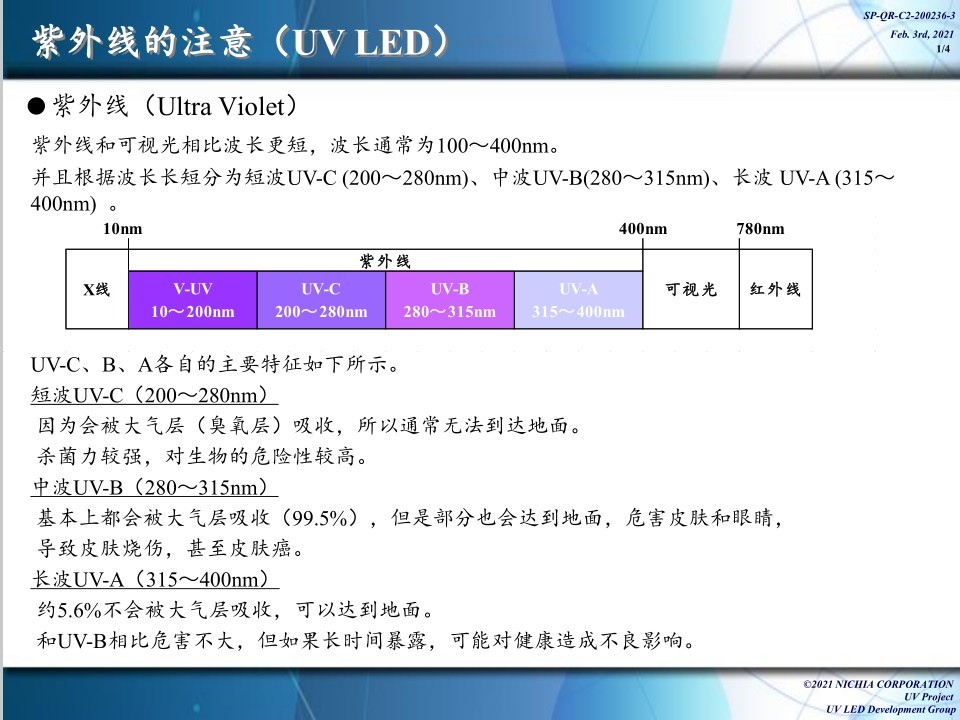
Ultraviolet light has a shorter wavelength than visible light, typically ranging from 100 to 400 nm.
Furthermore, it is classified according to wavelength into short-wave UV-C (200–280 nm), medium-wave UV-B (280–315 nm) and long-wave UV-A (315–400 nm)
The main characteristics of UV-C and BA are set out below.
Short-wave UV-C (200–280 nm)
As it is absorbed by the atmosphere (the ozone layer), it usually does not reach the ground. It has a high sterilisation rate and poses a significant risk to living organisms.
Medium-wave UV-B (280–315 nm)
Most of it is absorbed by the atmosphere (99.5%), but some does reach the ground, where it can damage the skin and eyes, causing skin burns and even skin cancer.
Long-wave UVA (315–400 nm)
Approximately 5.61 TP3T will not be absorbed by the atmosphere and will reach the ground.
Although it is less harmful than UV-B, prolonged exposure may have adverse effects on health.
Wearing a full set of UV-protective gear can prevent UV rays from causing harm to the human body.UV-protective clothing,UV-protective sunglasses,UV-protective face shield。