
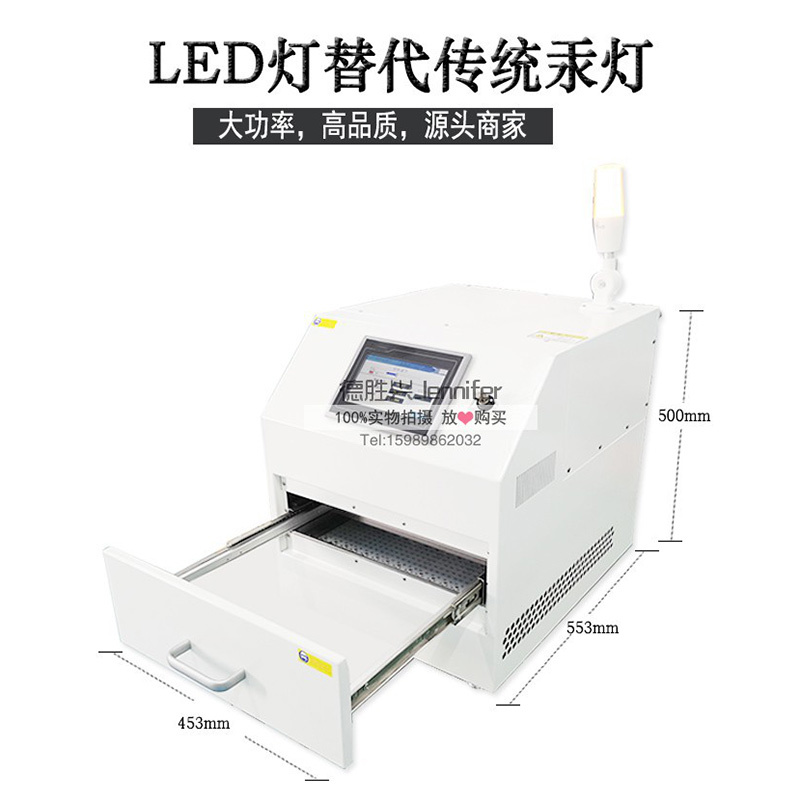
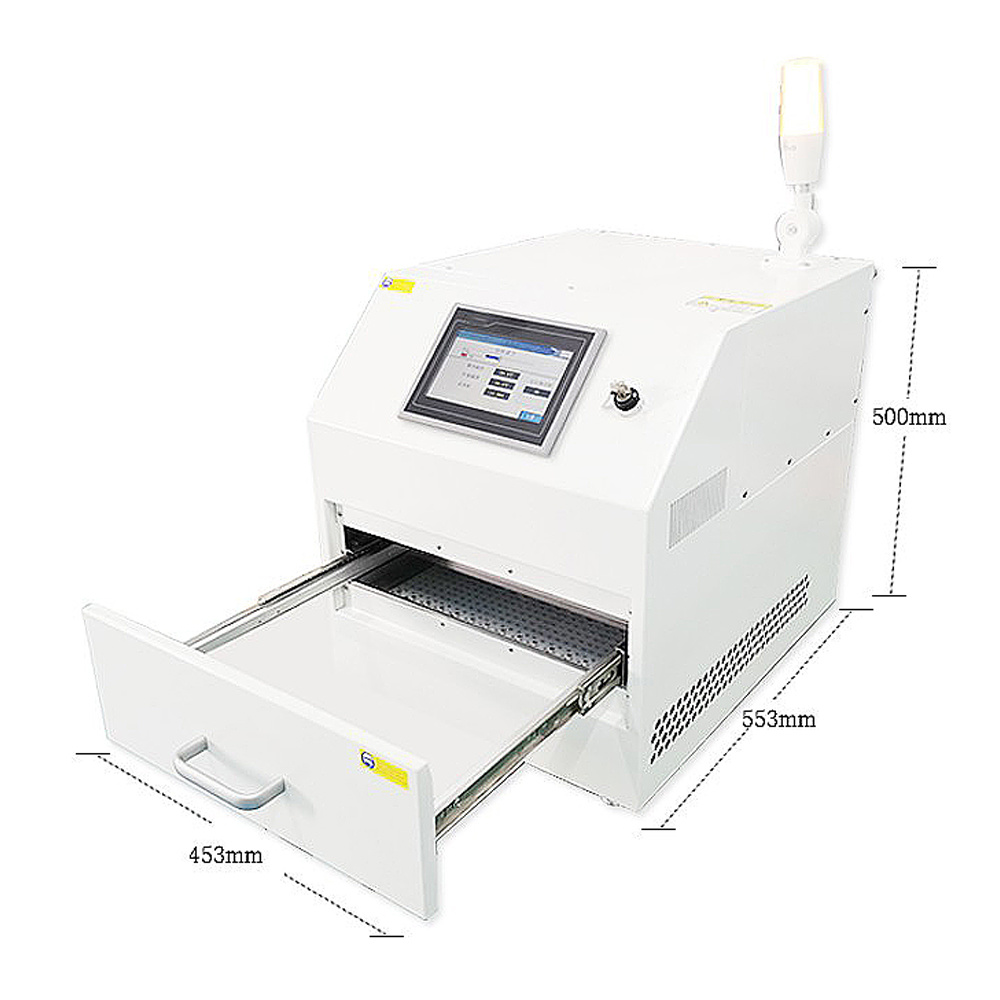
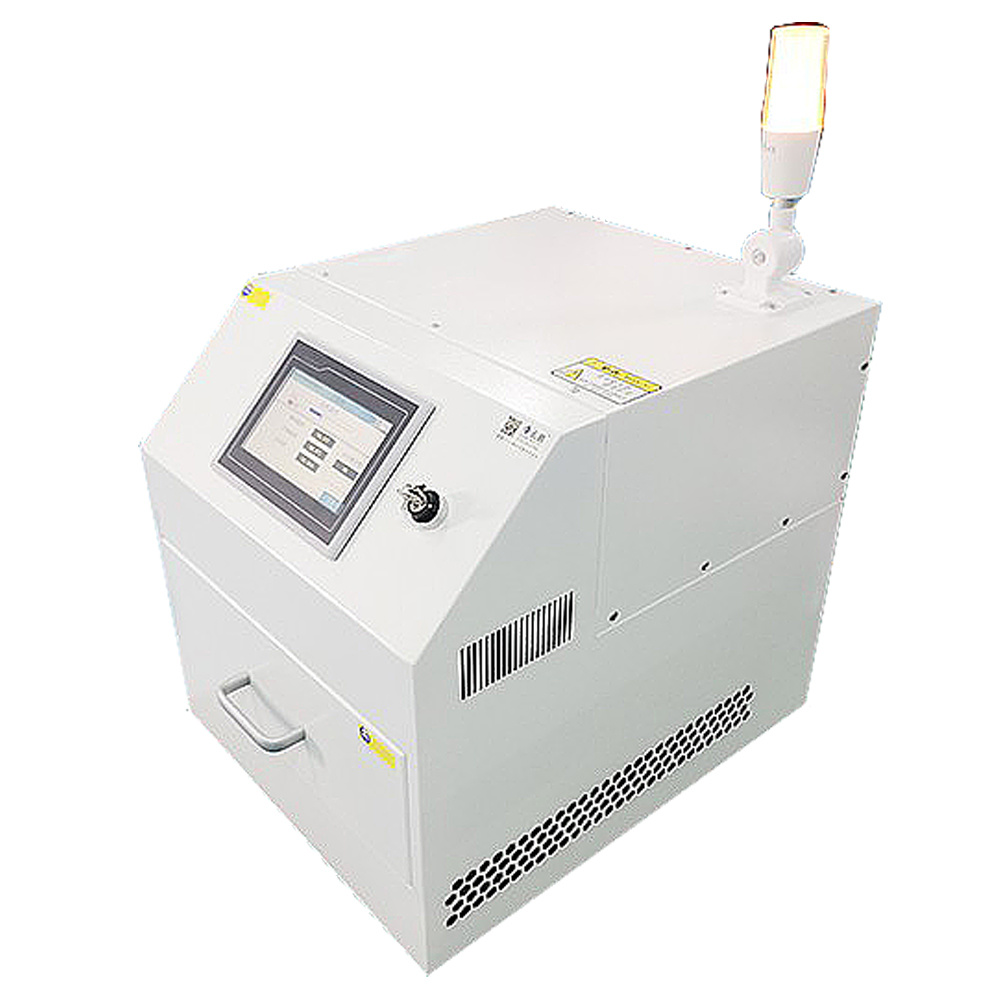
UV LED de-bonding machine; UV LED curing oven with UV light shield; semiconductor UV film de-bonding and curing chamber; semiconductor UV de-bonding machine
Use of UV film for debonding semiconductor materials such as optical lenses, LEDs, ICs, semiconductors, printed circuit boards and portable hard drives


Performance of the UV de-gelling machine:
The curing time for the adhesive is generally 30–40 seconds; however, depending on the adhesive properties and suitability of the adhesive film, as well as the wavelength of the lamp, the curing time may be longer or shorter. Nevertheless, this system is highly versatile,
For example, it can be used in research and development and on a wide variety of production lines; it is suitable for the removal of UV-cured coatings from semiconductor materials such as optical lenses, LEDs, ICs, semiconductors, printed circuit boards and portable hard drives.
Features of the UV de-gelling machine:
1. Wafer sizes: available in 6-inch, 8-inch and 12-inch
2. The operator simply needs to place or remove the workpiece; all other tasks are fully automated.
3. This compact, desktop model features an imported cold light source that emits light uniformly at a wavelength of 350–400 nm, thereby removing the adhesive from the film.
4. With its low operating temperature, uniform exposure, compact design and low energy consumption, it is the ideal model for the semiconductor industry.
Further Reading
Among manufacturers of standard dispensing machines—such as those producing dispensing controllers—domestic imitation technology has already reached a high level of maturity. Market competition is extremely fierce, and prices have plummeted; machines costing as little as a few hundred are now available.
However, dispensing machines manufactured in China generally suffer from a lack of precision and inconsistent dispensing; in certain high-tech industries, when it comes to purchasing a dispensing machine, one has no choice but to turn to global brands.
So, when it comes to high precision, we need all those with the ambition to make further efforts. In a fiercely competitive market, it is only through quality and service that one can stand out from the crowd.
Methods for wire drawing on dispensing machines
Delay in delamination
When the nozzle head is opened, there is a gap between the nozzle outlet and the valve, and there is no adhesive in this gap. If movement commences immediately after the nozzle outlet is opened, this will result in a short section of the track being left without adhesive.
To avoid this situation, after the adhesive has been applied, a short delay should be observed to allow the adhesive to flow out before proceeding with the next step. This delay is known as the adhesive application delay.
Delay in closing the mould
After sealing the nozzle, there is still some adhesive remaining between the nozzle outlet and the adhesive valve; if the machine is moved immediately after sealing the nozzle, this may result in adhesive trailing.
To prevent a dispensing error, after sealing the dispensing head, allow a short delay to ensure all the adhesive has been dispensed before proceeding with the next step. This delay is known as the dispensing delay.
Drawing height
As some adhesives have a high viscosity, the adhesive filament can only be broken by raising the applicator at a constant, slow speed over a certain distance without affecting the dispensing path; this distance is known as the filament-breaking height.
Lifting height
Once dispensing on a section of the track is complete and the head moves to the start of the next section, in order to prevent the dispensing head from colliding with the pins, the head is raised slightly at the end point to ensure it does not strike the pins,
Then move the load to the starting point of the next section of track; this distance is known as the lift height.
Early closure of the mould
”Early adhesive shut-off” refers to the early shut-off interval; in continuous track adhesive application, this involves shutting off the adhesive head before reaching the end point, allowing residual pressure and residual adhesive to complete the final section of the track, thereby preventing adhesive build-up at the end.
The length of this track is known as the “seal interval”. End of operation
Once dispensing along the entire taught path has been completed, in order to facilitate the loading and unloading of workpieces, improve processing efficiency or eliminate processing errors, the user may set the dispensing head to move to a specified position,
Either the start point of the machining file, the end point of the machining file, a return to home, or file concatenation. This process is known as the completion action.
Diagonal pull-up
Due to the viscosity of the adhesive, attempting to draw a thread immediately after the nozzle is sealed will not result in the thread breaking, or the shape of the drawn thread may not meet the requirements. Therefore, after sealing the nozzle, a diagonal upward pulling motion should be performed to prepare for thread drawing.
Heating the adhesive
You could try heating the glue to a suitable temperature; this will improve its flow and, to some extent, help prevent stringing! Be careful not to heat it to too high a temperature!