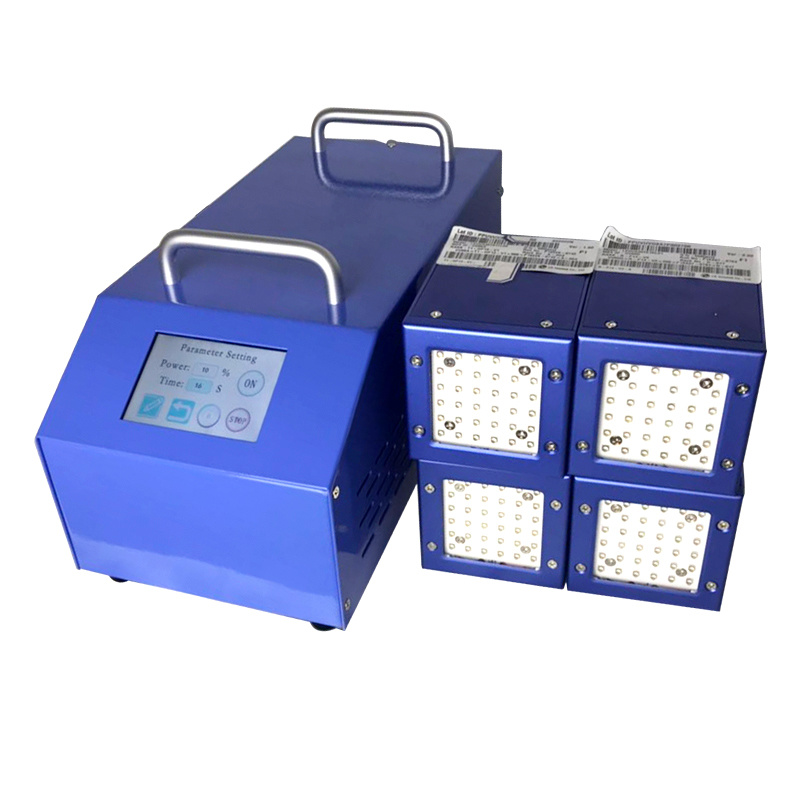
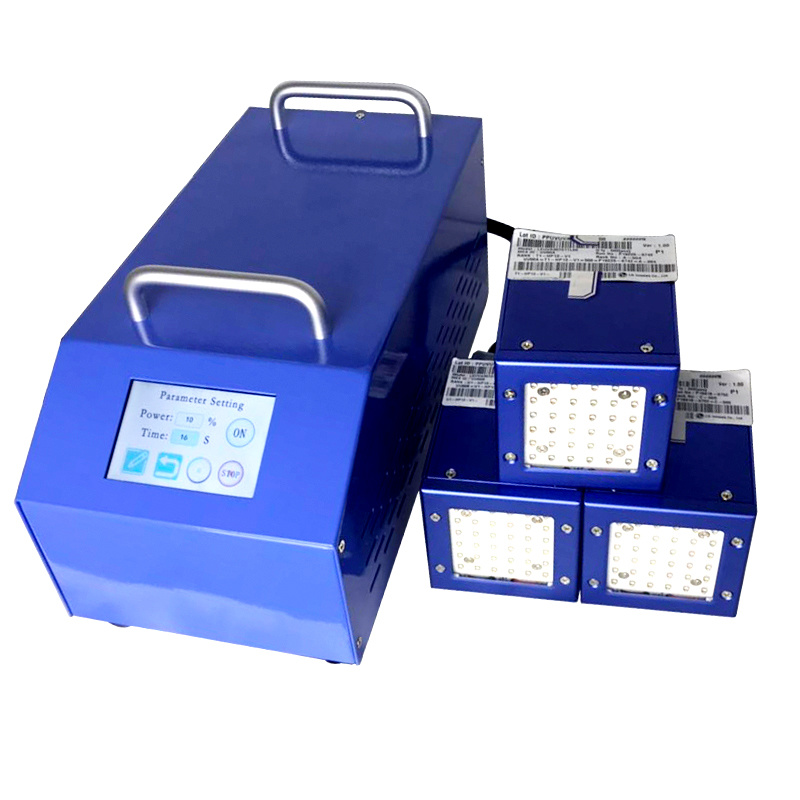
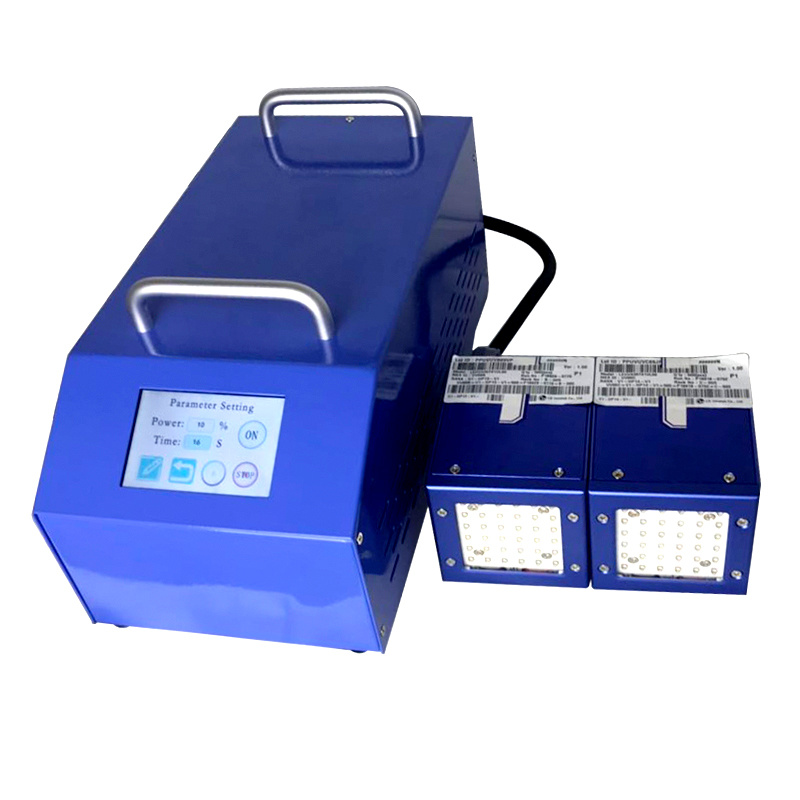
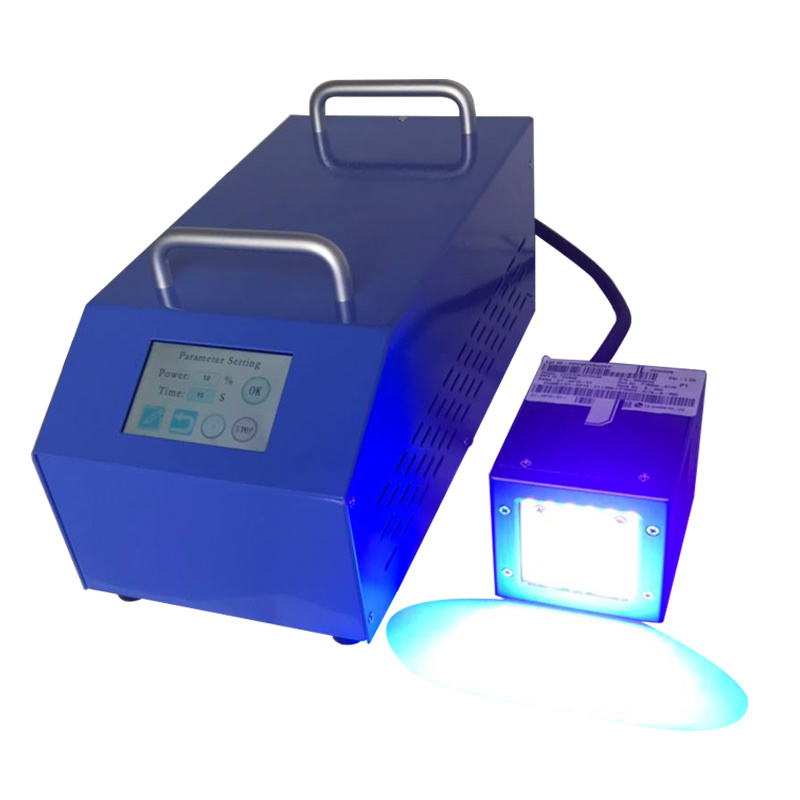
Four-wavelength UV LED (365 nm, 385 nm, 395 nm, 405 nm) ‘one-to-four’ UV curing lamp, area 50 × 50 mm
50×50 mm ‘one-to-four’ UV LED area light source: capable of operating simultaneously across four workstations or independently at each station.
The Napolun ‘One-to-Four’ four-channel LED UV curing unit is a controller that drives four curing heads.
These four irradiation heads may operate in four different UV wavelength bands, or they may all operate in the same UV wavelength band.
Controller specifications:
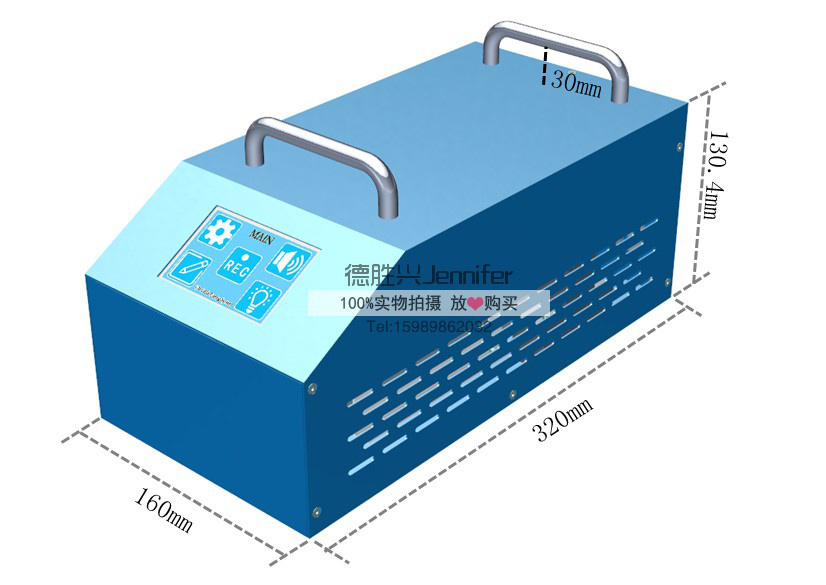
Four-band UV LED (365 nm, 385 nm, 395 nm, 405 nm) ‘one-to-four’ UV curing lamp
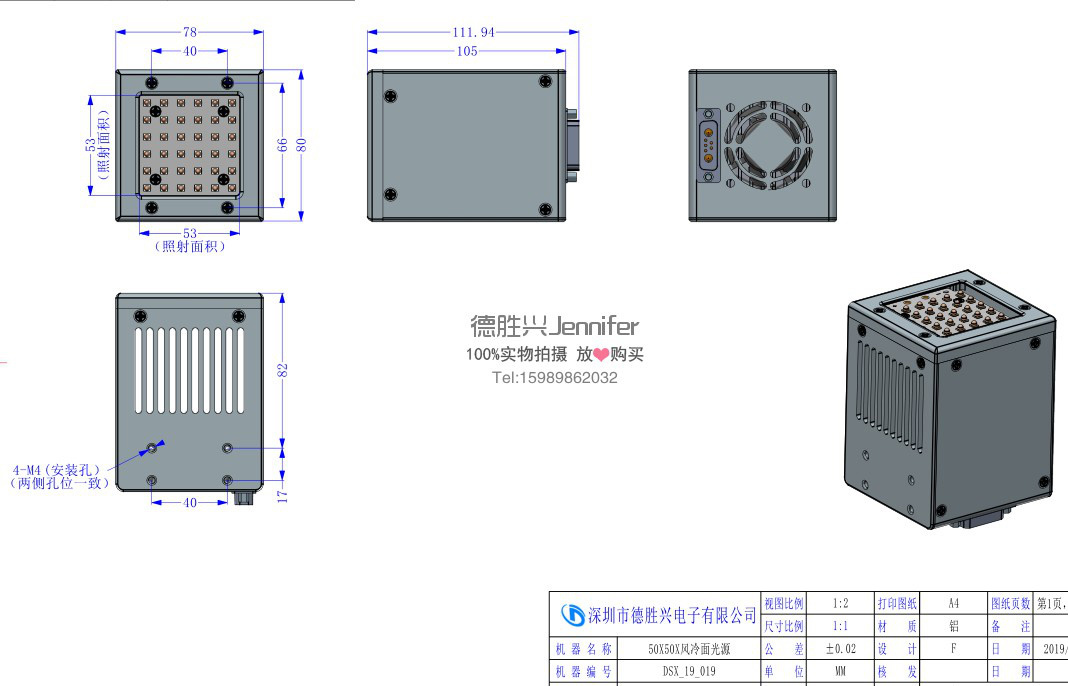
Dimensions: 50 × 50 mm
50×50 mm ‘one-to-four’ UV LED area light source: capable of operating simultaneously across four workstations or independently at each station.
The Napolun ‘One-to-Four’ four-channel LED UV curing unit is a controller that drives four curing heads.
These four irradiation heads may operate in four different UV wavelength bands, or they may all operate in the same UV wavelength band.
Please refer to the specifications sheet supplied at the time of dispatch for the installation dimensions shown in the figure below. The specifications at the time of dispatch shall prevail.
Advantages of UV LED Area Light Sources
Single-wavelength UV light output, with no harmful thermal effects
Utilising high-power LEDs to emit a single-wavelength light source, the product is highly targeted and efficient.
The influence of light emitted by sources other than the main wavelength has been eliminated.
In particular, as it does not emit infrared radiation, it significantly reduces the thermal impact on the workpiece. It is the ideal light source for high-precision curing, where thermal effects are a major concern.
For example, the assembly of ultra-thin resin lenses. Low power consumption, energy-saving
It achieves a low power consumption equivalent to just a few tenths of that of a UV mercury lamp. The product can significantly reduce annual energy consumption and waste emissions.
Reduces environmental impact. Flexible layout, space-saving
By using UV-LEDs, the unit is approximately 90% smaller than UV mercury lamp models. It is also significantly lighter, eliminating concerns about installation space and allowing for greater freedom in layout.
The irradiation heads can be controlled individually or simultaneously, thereby reducing capital expenditure on equipment
Select the number of irradiation heads as required; multiple conventional mercury UV lamps can now be replaced by a single UV LED line or area light source.
This reduces capital expenditure, whilst the irradiation heads can be controlled individually or in unison, depending on on-site process requirements.
Consistent output accuracy
By employing unique heat dissipation technology in the UV-LED sector, we have developed a cooling method that balances high light output with a long service life, minimising drift and ensuring stable illumination.
Long service life, reduced running costs
Compared with UV mercury lamps, LED lamps have a significantly longer service life. This is precisely what characterises LED technology. Unlike UV mercury lamps, which must remain switched on at all times, UV LEDs can be switched on and off instantly; consequently, the difference in actual service life is even greater.
By utilising a proprietary optical system, this UV irradiation minimises variations in light intensity across a wide area. It helps to prevent curing,
Curing deformation of drying spots and adhesives, assisting customers with quality management.
Detailed Areas of Application: UV LED area light sources measuring 100 × 100 mm are used in the following industries in which you operate:
1. UV-curable screen-printing varnish
It can be used for spot varnishing or full-surface varnishing. The varnished surface features vibrant, glossy and transparent colours with a photographic finish; it is wear-resistant, does not peel or curl, and is used for the decorative and protective finishing of high-end packaging.
Product features:
a. The product is odourless, solvent-free, causes minimal skin irritation and cures quickly.
b. The product has excellent defoaming and levelling properties, making it suitable for high-speed printing on automatic printing presses.
c. The product exhibits excellent adhesion and fold resistance on gold and silver cardstock.
d. The product’s viscosity is adjustable to suit screens of different mesh counts, making it suitable for printing on a wide range of wine boxes and cigarette packets.
2. UV plastic varnish (suitable for hot foil stamping)
Primarily used for roller coating on the surfaces of PE and PP films or sheets; suitable for gloss finishing on toothpaste tubes, PE tubes and self-adhesive film surfaces.
Product features: Resistant to yellowing, low odour, abrasion-resistant, high gloss and good flexibility. This range also includes a UV matt varnish.
3. UV varnish for CD protection
Disc protective coating is a key material in disc production and is crucial to disc quality; it must adhere well to the disc’s reflective metal layer, be highly compatible with printing inks, and exhibit good performance at both high and low temperatures,
Excellent wear resistance: our company’s Shenzhen Deshengxing Technology products possess the aforementioned characteristics.
4. UV-curable adhesives
Features: A single-component UV-curing adhesive; UV-curing adhesives are not only easier to use than traditional two-component thermosetting adhesives, but also offer the following features.
Optical properties: The liquid crystal adhesive is crystal-clear; after curing, its light transmittance is ≥90%.
Adhesive properties: Low volume shrinkage after curing, high elongation and high adhesive strength.
Weather resistance: Once cured, the adhesive exhibits excellent weather resistance; it does not yellow when exposed to prolonged ultraviolet radiation and has high resistance to both high and low temperatures, making it suitable for use in a temperature range of –50 to 80 degrees Celsius.
Uses: For the rapid bonding of transparent materials such as transparent plastics, glass and metals, as well as non-transparent materials such as plastics, ceramics and rubber; the curing time can be as fast as 1 second, and the bond strength is adjustable.
, suitable for bonding, encapsulation or mounting applications involving optical discs, electronic components, optical communication components, biological products, furniture and the like.
a. UV disc adhesive: UV disc adhesive, suitable for the production of DVD-5 and DVD-10 discs.
b. Glass–aluminium alloy adhesive (UV-curing adhesive): Widely used in optical instruments, medical devices, handicrafts, furniture and the construction industry, for bonding glass to metal,
Bonding of glass to glass, metal to metal, etc.
Instructions for use: First, clean the surface of the object to be bonded thoroughly and allow it to dry. Apply a small amount of adhesive to the surface of the object to be bonded, then press the surfaces firmly together to remove any air bubbles from the adhesive layer, ensuring that the adhesive layer is less than 25 μm thick,
After application, cure the resin by exposing it to a high-pressure mercury lamp (power: 60 W/cm) at a distance of 10 cm for 10–20 seconds (curing times may vary slightly depending on the light-curing material and the lamp used). The properties of the light-curing resin will reach their optimum after half an hour.
5. UV-curable soft rubber
Uses: To provide a protective, transparent finish for trademarks, badges, labels, etc.
Features: The liquid adhesive is stable in storage and cures rapidly upon exposure to ultraviolet light; the cured adhesive is transparent and elastic, and is scratch-resistant; indentations and scratches disappear of their own accord.
Instructions for use: Once the resin has been dispensed, it may be placed in a light-curing oven for curing. The resin layer should not exceed 2 mm in thickness. Curing conditions: high-pressure mercury lamp, 60–80 M/cm; curing time: 10–25 seconds.
6. UV-cured marble-effect coating
UV marble varnish, used for decorating marble, engineered stone, ceramic stone and similar materials, provides a bright finish with a distinctive effect; it reduces energy consumption in stone production and improves production efficiency.
7. UV-curing adhesive
For bonding glass to glass, glass to metal, plastic to plastic, and plastic to metal.
Features: Fast curing, high bond strength, no yellowing, no bubbling. Cures within 20 seconds in sunlight.
UV LED Area Light Sources in Smartphone Applications
1. Bonding the mobile phone screen to the frame
2. Bonding of mobile phone casings
3. Adhesive fixing of the side buttons
4. Positioning the camera window
5. Affixing the logo
6. The cover of the sound chamber in the smartphone
7. Between the FPC antenna and the casing of a smartphone
8. On the camera module, between the holder and the FPC (the area where the FPC is bent)
9. Secure the wiring for the flat motor on the mobile phone.
10. Securing the mobile phone’s motherboard
Microelectronics Industry – UV Curing Applications
1. Mobile phone component assembly (camera lenses, earpieces, microphones, casings, LCD modules, touchscreen coatings, etc.)
2. Hard disk head assembly (gold wire bonding, bearings, coils, chip bonding, etc.)
3. DVD players/digital cameras (lenses, lens bonding, circuit board reinforcement)
4. Assembly of motors and components (wiring, securing coils, securing coil ends, bonding PTC/NTC components, securing the protective transformer core)
5. Semiconductor chips (moisture-proof protective coating, wafer masking, wafer contamination inspection, UV tape exposure, wafer polishing inspection)
6. Sensor manufacturing (gas sensors, photoelectric sensors, fibre-optic sensors, optical encoders, etc.)
Applications of UV LED Curing in the PCB Industry
1. Securing components (capacitors, inductors, various plug-in components, screws, chips, etc.)
2. Moisture-proof potting and protection of core circuits and chips; anti-oxidation coating protection
3. Conformal (corner) coating for printed circuit boards
4. Earth wire, jumper wire, coil fixing
5. Through-hole mask for wave soldering
Applications of UV LED Curing in Medical Devices
UV adhesive bonding facilitates the cost-effective, automated assembly of medical devices. Nowadays, advanced LED UV light systems can cure the adhesive in a matter of seconds.
Solvent-free UV adhesives, together with dispensing systems, provide an effective and cost-efficient method for achieving consistent and repeatable bonding in the assembly of medical devices.
The optimisation and control of UV light sources are crucial for the manufacture of reliable medical devices. The use of UV-curable adhesives offers numerous advantages, such as lower energy requirements,
Saves curing time and space, boosts productivity and facilitates automation. UV adhesives are generally used to bond and seal medical devices, which require a very high level of
Quality and the highest reliability. UV adhesives are typically used in the assembly of medical devices, such as those requiring bonding
1) Different materials (or materials with different mechanical properties) 2) The material is not thick enough to allow welding 3) Sub-assemblies are produced in advance...
1. Anaesthetic mask 2. Syringe 3. Infusion tube 4. Intravenous drip tube 5. Vascular access accessories 6. Endoscope 7. Arterial positioning device 8. Tubular drainage device
9. Tracheal tubes 10. Blood oxygenators 11. Hearing aids 12. Detection, monitoring and imaging devices 13. Biochips 14. Bonding of PVC and thermoplastics (polycarbonate and ABS)
Optical Industry – ST-UV LED Light-Curing Applications
1. Optical component assembly (lens assemblies, prisms, optical engine assemblies)
2. Assembly of imaging equipment (microscopes, endoscopes, infrared devices, night-vision devices, probes, etc.)
Applications of UV LED Curing in the Optical Communications Industry
1. Passive components (wavelength division multiplexers (WDM), arrayed waveguide gratings (AWG), optical splitters (SPLITTER), optical isolators (ISOLATOR), optical couplers (COUPLOR), etc.),
Bonding or potting of various glass packaging structures, and the securing of micro-components, etc.
2. Active devices (coaxial devices such as TOSA, ROSA and BOSA; VCSELs; laser collimators, etc.), particularly low-cost, miniaturised plastic packaging structures for FTTX applications
3. Optical fibre cables (outer coating, marking, bonding, fibre-optic gyroscopes)
Research and Academic Institutions – ST-UVLED Light-Curing Applications
1. Polymer chemistry (nanocoatings, light-curing resins, photosensitisers, monomers, UV inks, etc.)
2. Medical polymer materials (medical plastics, catheters), microbiology
3. Photochemistry (photocatalysis, photoexcitation, photosynthesis, etc.)
4. Semiconductors (photo-accelerated etching, cutting, UV-curable tape, etc.)
Other applications
1. UV analysers, biological and genetic engineering, molecular genetics, medicine and public health, biological products, pharmaceutical research, public health and epidemic prevention, dye chemistry,
The petrochemical and textile industries, **law enforcement agencies**, and cultural heritage and archaeological departments—in short, any organisation requiring fluorescence analysis and verification—may use this equipment.
2. Biochemistry, microbiology, genetics, medicine and catalysis: each channel utilises UV LEDs of different wavelengths, ranging from 240 nm to 410 nm in 5 nm increments, to enable detailed analysis
3. UV therapy devices for medical applications, such as dental curing, vitiligo treatment and the promotion of wound healing.
4. Standard light source: as the light spectrum emitted by LEDs is relatively uniform and consistent in energy, they can serve as an effective standard light source
5. Forensic lighting sources, when combined with high-power LEDs, can emit light of various colours with consistent intensity across the spectrum from 365 nm to 780 nm, ranging from ultraviolet, violet, blue, green, cyan, yellow, orange and red,
It can provide light across 12 bands, ranging from the visible to the infrared spectrum, and includes a white light.
Curing of FPC surface protective resin Features of UV LED line light sources:
1: Cold light source with no thermal radiation; particularly suitable for LCD edge sealing and film printing applications where a small heating area is required.
2: Instantly illuminates, immediately reaching a UV output of 1001 TP3T, with an irradiance of 8,000–9,000 mW/cm².
3: Compact design – enabling the equipment to be easily integrated into fully automated production lines and machinery.
4: It does not use toxic substances and does not produce ozone, making it a safer and more environmentally friendly alternative to traditional light sources.
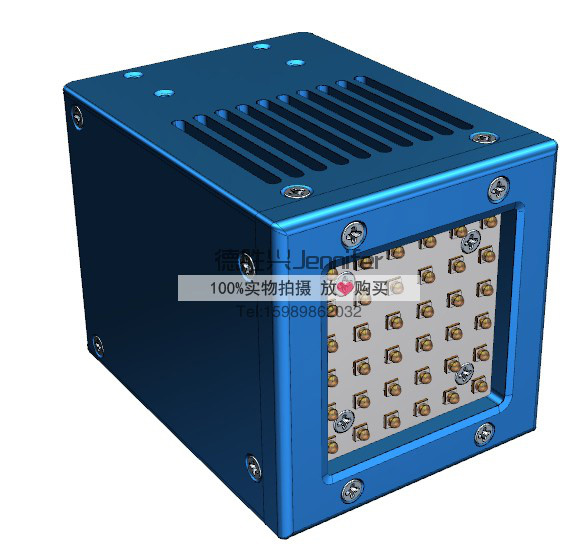
| Illuminated area | 50 × 50 mm | Electrical power | 100W |
| Dimensions | L 78 × W 112 × H 8 mm | Recommended height | 5–20 mm |
| Cooling | Air-cooled | Wavelength | 365 / 385 / 395 / 405 |
| Material / Weight | Sheet metal / 0.8 kg | Luminous power (mW/cm²) | 1000–2000 mW/cm² by EIT |
| Predicted service life | 20,000 H | ||
| Power supply specifications | 130V 0.6A | Cable length | 2 / 5 m |