


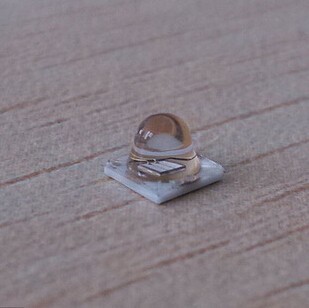
CUN86B1B 380nm 3W 45° UV LED, specifically designed for curing UV inks and exposure units, in stock
CUN86B1B Seoul, South Korea SVC 380nm 3W violet LED curing light source for light-curing/exposure machines; high-power LED chips. This platform brings together a large number of suppliers, buyers and manufacturers.
In industries such as exposure and printing, UV energy decreases as the distance increases; if the lamp beads have a wide beam angle, the greater the distance, the more pronounced the decrease,
The CUN86B1B is a product specifically developed for exposure units and printing presses. It is designed with a 45° beam angle to ensure a more concentrated and powerful light output, delivering a light power of up to 1,100 mW when driven at 500 mA.
Single-electrode vertical-structure chips versus dual-electrode structure chips
Unlike dual-electrode chips on sapphire substrates, single-electrode vertical-structure chips do not suffer from light loss through the sides; moreover, this characteristic of single-electrode chips enables maximum efficiency to be achieved.
The ceramic substrate design provides better heat dissipation; the LED chips can be thermally decoupled, resulting in improved thermal conductivity and a longer service life.
In exposure machine applications, the method of seamlessly joining small panels is used to create line or surface light sources. Compared to traditional mercury lamps, these require no warm-up time and are ready for immediate use; they do not produce ozone, making them more environmentally friendly, with lower maintenance costs and greater energy efficiency, saving over 50% in electricity costs per year.
Seoul Semi is one of the world’s top 10 LED manufacturers. The company has grown rapidly in recent years and has now established itself as a leading global manufacturer of LED chips.
Seoul Semiconductor has launched ultra-bright, ultra-compact flash LEDs to replace the xenon flashes commonly used in digital cameras or 5-megapixel camera phones.
Seoul Semi’s main products include LED packaging and customised module products, including AC-powered semiconductor light sources such as Acriche, high-brightness high-power LEDs, side-emitting LEDs, top-emitting LEDs, surface-mount LEDs, through-hole LEDs and ‘Piranha’ (ultra-bright) LEDs.
The product is widely used in general lighting, display lighting, mobile phone backlighting, televisions, laptops, automotive lighting, household goods and traffic signals, amongst other applications.
SEOUL VIOSYS, a Seoul-based company with the vision of becoming a global leader in providing UV light across all wavelengths, is a company with boundless potential that has grown two to three times over each year since its establishment.
In order to grow alongside Seoul Ban Dao Qi, a specialist LED company, and develop into a global enterprise, we will further enhance customer satisfaction through our competitive quality and pricing.
Our company has Seoul Optoelectronics SVC’sCUN96B1B AND the price advantage of the CUN86B1B. It is also available with a range of complementary UV LED equipment.
SVC (Hanban) UV LED, Seoul, South Korea:
1chip Z5 AAP package: 365 nm, 375 nm, 385 nm, 395 nm, 405 nm,
4-chip AAP package: 365 nm, 385 nm, 395 nm
DUV: 275 nm
The specific models are as follows:
UV LED chips:
T9L28, CUD8AF1A, CUN6AF1A, CUN7AF1A, CUN8AF1A, CUN9AF1A, CUN0AF1A, CUN66A1A, CUN76A1A, CUN86A1A, CUN96A1A, CUN6AF4A, 5050-C, CUN0CF2, CUN66A1B, CUN86A1B, CUN96A1B, CUN06A1B, CUN86B1B, CUN96B1B, CUN06B1B, CUN6AF1B, CUN7AF1B, CUN8AF1B, CUN9AF1B, CUN0AF1B
Jannie 15989862032
UV curing applications for the CUN96B1B computer monitor:
Displays are now widely used in electronic devices, including watches, calculators, computer monitors, television screens, cameras and clocks, test instrument readouts, automotive instrument clusters, and personal digital assistants (PDAs).
The Advantages of UV Curing Technology in Display Curing
1. Environmentally friendly light source: contains no harmful mercury and emits no red light or ultraviolet radiation;
2. Long service life: The product has a service life of up to 30,000 hours, which equates to three years of continuous 24-hour operation;
3. Nanosecond-level response speed: enables digital control;
4. Low power consumption: whilst delivering the same light-curing results, it consumes 90% less electricity than traditional UV mercury lamps.
5. Greater energy efficiency, higher performance, greater luminous intensity, better value for money, and a more stable photoelectric effect;
UV curing technology for displays differs from UV LED screen-printing curing technology. Whilst screen-printing curing technology primarily utilises UV LED area light sources, UV curing technology for displays mainly employs 365 nm or 395 nm point or line light sources.
However, the CUN96B1B and CUN86B1B models from Seoul SVC, which our company represents, perform even better.
UV light-curing technology is used in the manufacture of liquid crystal displays as follows:
① Temporary fixing of the photovoltaic modules for alignment.
② Mainboard sealing.
③ Port sealing.
④ Bonding of metal lead terminals.
⑤ Flexible termination.
⑥ Bare-die mounting.
⑦ Co-directional in-situ bonding and film lamination, as well as FCOG cover coating.


Shenzhen Headquarters: Deshengxing Electronics
Dongguan Office: Room 401, Building 2, Shenjian Industrial Park, No. 183 Zhangluo Yongning Road, Zhangmutou Town, Dongguan (press 5 on the lift)
邮箱:394413500@qq.com
Tel: 13823605006
Copyright © Shenzhen Deshengxing Electronics Co., Ltd. Guangdong ICP Registration No. 16127298-1 Technical support: Honhoo Tech