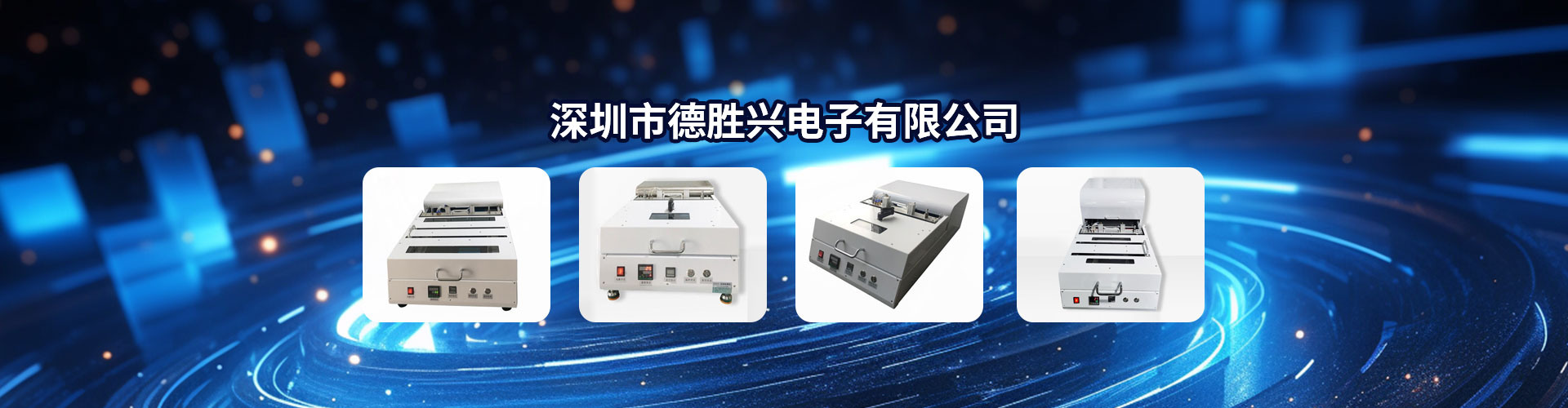
What is the difference between a UV de-gelling machine, a UV curing oven and a UV curing chamber?
What is the difference between a UV de-gelling machine and a UV curing unit? Answer: There is a difference.
What is the difference between a UV de-gelling machine and a UV curing cabinet? Answer: There is a difference.
Difference 1: The light emission method is different
UV De-gelling MachineThe standard light emission pattern for a gel-dissolving light source is generally from the bottom upwards, whilst ultraviolet light sources emit light from the bottom.
In UV curing units, the UV lamp is not located at the bottom; in most cases, the light is emitted directly from above.
Difference 2: UV debonding machines are standard models, with a fixed number of variants available depending on wafer size (6-inch, 8-inch and 12-inch). UV curing machines, on the other hand, are predominantly custom-built to specific specifications.
Difference 2: Different uses
UV delaminators are typically used to remove UV film, not for curing.UV-curable adhesive tape has very strong adhesion and holds the wafer firmly in place during the wafer polishing or dicing processes. When exposed to ultraviolet light, the adhesive strength is reduced, thereby enabling the tape to be removed.
UV ovens and UV curing chambers are used for curing purposes. UV curing refers to ultraviolet curing; ‘UV’ is the abbreviation for ultraviolet light, and curing refers to the process by which a substance undergoes a polymerisation reaction, transforming from a low-molecular-weight state to a high-molecular-weight state. UV curing generally refers to the curing conditions or requirements for coatings (paints), inks, adhesives or other encapsulants and sealants that require curing by ultraviolet light; it is distinct from heat curing, curing with cross-linking agents (curing agents) and natural curing.
One involves separating the semiconductor material on the wafer from the adhesive, whilst the other involves bonding the two materials together and allowing them to cure. These are contradictory yet distinct explanations. Have I made myself clear?
Applications of UV debonding machines: wafers,Used for the removal of adhesives from semiconductor materials such as LEDs, ICs, semiconductor wafers, printed circuit boards and portable hard drives, as well as from UV films such as glass filters and UV adhesive tapes.
Applications of UV curing ovens and UV curing chambers: UV adhesive bonding and UV ink curing; all of the following fall within the scope of curing applications.
Sub-sectors within the UV adhesive curing sector
1. Hard disk drive head assembly (packaging of read/write heads, gold wire bonding, bearings, coils, chip bonding, etc.)
2. Motor and component assembly (wiring, securing the coils, securing the coil ends, bonding PTC/NTC components, protecting the transformer core)
3. DVD players/digital cameras (lenses, lens bonding, circuit board reinforcement)
4. Sensor manufacturing (gas sensors, photoelectric sensors, fibre-optic sensors, optical encoders, etc.)
5. Mobile phone component assembly (camera lenses, earpieces, microphones, casings, LCD modules, touchscreen coatings, etc.)
6. Sealing of the encapsulation port on TFT-LCD panels
7. Bonding and encapsulation of the FPC for TFT-LCD panels
8. Applications of UV LED curing in the PCB industry.
9. Optics Industry – ST-LED UV Curing Applications
10. Assembly of optical components (lens assemblies, prisms, DLP optical engine assemblies, CCDs, CMOS sensors)
11. Applications of LED UV Curing in the Optical Communications Industry
12. Components for the optical communications industry (PLC splitters, WDM (wavelength division multiplexers), AWG (array waveguide gratings), and other glass-encapsulated structures—including bonding or potting, and the fixing of micro-components, etc.)
13. Research and Academic Institutions – ST-UV LED Light-Curing Applications
14. Applications of LED UV Light Sources for Curing in Medical Devices and Medical Accessories
15. Curing of the touchscreen laminate
16. Applications of UV-curing in laser packaging
Segmentation of the UV ink, UV varnish and UV coating sector
1. UV-curable screen-printing varnish
It can be used for spot varnishing or full-surface varnishing. The varnished surface features vibrant, glossy and transparent colours with a photographic finish; it is wear-resistant, does not peel or curl, and is used for the decorative and protective finishing of high-end packaging.
Product features:
a. The product is odourless, solvent-free, causes minimal skin irritation and cures quickly.
b. The product has excellent defoaming and levelling properties, making it suitable for high-speed printing on automatic printing presses.
c. The product exhibits excellent adhesion and fold resistance on gold and silver cardstock.
d. The product’s viscosity is adjustable to suit screens of different mesh counts, making it suitable for printing on a wide range of wine boxes and cigarette packets.
2. UV plastic varnish (suitable for hot foil stamping)
Primarily used for roller coating on the surfaces of PE and PP films or sheets; suitable for gloss finishing on toothpaste tubes, PE tubes and self-adhesive film surfaces.
Product features: Resistant to yellowing, low odour, abrasion-resistant, high gloss and good flexibility. This range also includes a UV matt varnish.
3. UV varnish for CD protection
Disc protective film is a key material in disc production and is crucial to disc quality. It must adhere well to the disc’s reflective metal layer, be highly compatible with printing inks, exhibit good performance at both high and low temperatures, and offer excellent wear resistance. Our company, Shenzhen Deshengxing Technology, manufactures products that possess all these characteristics.
4. UV-curable adhesives
Features: A single-component UV-curing adhesive; UV-curing adhesives are not only easier to use than traditional two-component thermosetting adhesives, but also offer the following features.
Optical properties: The liquid crystal adhesive is crystal-clear; after curing, its light transmittance is ≥90%.
Adhesive properties: After curing, it exhibits low volumetric shrinkage, high elongation and high adhesive strength.
Weather resistance: Once cured, the adhesive exhibits excellent weather resistance; it does not yellow when exposed to prolonged ultraviolet radiation and has strong resistance to both high and low temperatures, making it suitable for use in a temperature range of –50 to 80 degrees Celsius.
Applications: For the rapid bonding of transparent materials such as transparent plastics, glass and metals, as well as non-transparent materials such as plastics, ceramics and rubber. The curing time can be as fast as 1 second, and the bond strength is adjustable. Suitable for bonding, encapsulation or mounting applications in optical discs, electronic components, optical communication devices, bioproducts and furniture.
a. UV disc adhesive: UV disc adhesive, suitable for the production of DVD-5 and DVD-10 discs.
b. Glass–aluminium alloy adhesive (UV-curing adhesive): Widely used in the optical instrument, medical device, craft, furniture and construction industries for bonding glass to metal, glass to glass, metal to metal and other such combinations.
Instructions for use: First, clean the surface of the object to be bonded thoroughly and allow it to dry. Apply a small amount of adhesive to the surface of the object to be bonded, then press the surfaces firmly together to expel any air bubbles from the adhesive layer, ensuring the adhesive layer is less than 25 μm thick. After application, cure the adhesive by exposing it to a high-pressure mercury lamp (power: 60 W/cm) at a distance of 10 cm for 10–20 seconds (curing time may vary slightly depending on the translucent material and lamp used). The properties of the shadowless adhesive will reach their optimum after half an hour.
5. UV-curable soft rubber
Uses: To provide a protective, transparent finish for trademarks, badges, labels, etc.
Features: The liquid adhesive is stable in storage and cures rapidly upon exposure to ultraviolet light; the cured adhesive is transparent and elastic, and is scratch-resistant; indentations and scratches disappear of their own accord.
Instructions for use: Once the resin has been dispensed, it may be placed in a light-curing oven for curing. The resin layer should not exceed 2 mm in thickness. Curing conditions: high-pressure mercury lamp, 60–80 M/cm; curing time: 10–25 seconds.
6. UV-cured marble-effect coating
UV marble varnish, used for decorating marble, engineered stone, ceramic stone and similar materials, provides a bright finish with a distinctive effect; it reduces energy consumption in stone production and improves production efficiency.
7. UV-curing adhesive
For bonding glass to glass, glass to metal, plastic to plastic, and plastic to metal.
Features: Fast curing, high bond strength, no yellowing, no blistering. Cures within 20 seconds in sunlight.