
UV LED Welding Methods
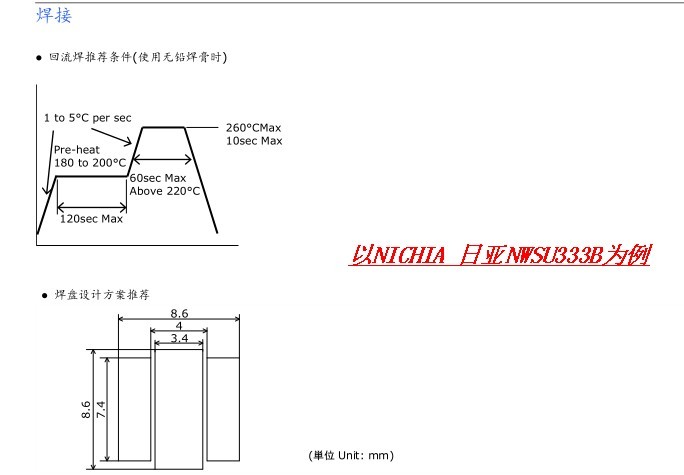
1. UV LED products are suitable for reflow soldering, and reflow soldering is recommended. Nichia cannot guarantee their reliability if they are used in dip soldering or hand soldering.
2. Reflow soldering must not be carried out more than twice.
3. The cooling zone of the reflow soldering temperature profile should be allowed to cool down gradually. Rapid cooling may subject the LEDs to excessive stress; therefore, this must be thoroughly validated before setting the reflow soldering conditions.
4. When using a reflow soldering process, it is best to use a nitrogen-based reflow soldering process, as an air-based process may cause the LEDs to be affected by the heat and atmospheric conditions during reflow soldering, resulting in poor optical performance.
5. No repairs may be carried out after welding. If repairs are unavoidable, it must be confirmed in advance that they will not affect the LED’s performance.
6. Avoid applying external force to the LED whilst it is heated during the welding process.
7. When using an automatic surface-mount placement machine for assembly, please select a nozzle suitable for this product.
8. The pad dimensions recommended by Japan Asia are intended merely to ensure that no problems arise during soldering. Where higher mounting precision is required, such as in high-density mounting, pad designs appropriate to the application should be used.
9. When using flux, it is best to use halogen-free flux. Furthermore, during the production process, one should avoid applying the flux directly to the LEDs.
10. Always check the type and quantity of solder before soldering.
The above outlines the recommended standard process for the bulk soldering of all LEDs. Please refer to this. For technical enquiries, please contact Jennifer on 15989862032.