
How can the cost of UV LED quartz glass packaging be reduced?

Quartz lensThe cost structure comprises, in particular, materials, dimensions, dimensional accuracy and the complexity of the manufacturing process.
1. Materials: Common materials capable of transmitting UVC include synthetic quartz JGS1, fused quartz JGS2 and sapphire. In the UVC 250–280 nm wavelength band, synthetic quartz JGS1 has a transmittance 1–31 TP3T higher than that of fused quartz JGS2, and its price is several times that of JGS2. Currently, substandard sapphire is used for encapsulation on the market; experimental data indicate that in the UVC 250–280 nm wavelength band, the transmittance of sapphire is approximately 5–101 TP3T lower than that of quartz. Furthermore, sapphire of comparable quality is generally more expensive than quartz; consequently, sapphire is not suitable for use in UV LED encapsulation or module applications.
2. Dimensions: The smaller the volume, the lower the cost; therefore, the original state of the material should be chosen appropriately.
3. Complexity of the manufacturing process: Different manufacturing processes are required for different shapes, and the corresponding cost implications are set out in the table below:
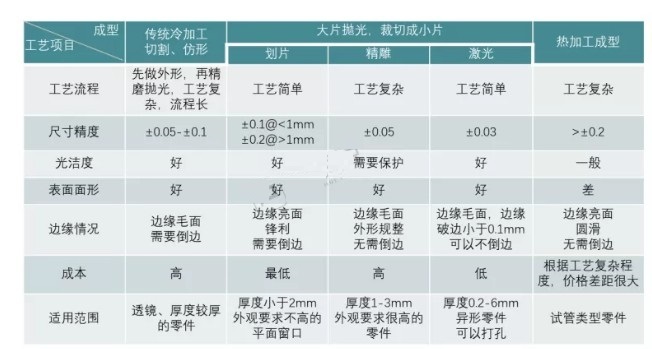
Coating the lenses can effectively increase the transmittance by 6% or more.
4. Precision requirements for parts: These are primarily reflected in four aspects: dimensional accuracy, surface finish, surface profile and edge treatment;
In short,By modifying and controlling aspects such as the material, external structure, dimensional accuracy and coating, the cost of quartz lenses can be effectively reduced.It is therefore recommended that packaging and module manufacturers involve lens manufacturers at the product design stage in order to control the cost of quartz lenses.
Finally, I’d like to share a case study of a water purification module client who successfully reduced the price of quartz lenses by 40%.
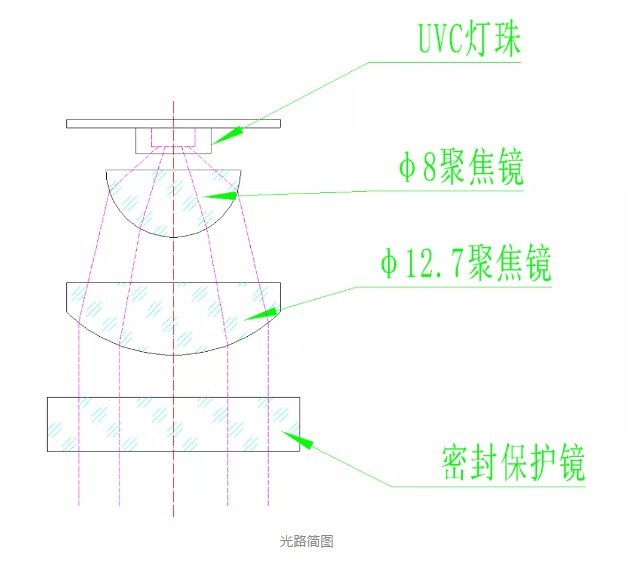
By collaborating with the client to design the optical path diagram, we incorporated a φ8 focusing lens, a φ12.7 focusing lens and a φ18 protective window. A set of lenses was used to collimate the light and reduce scattering, thereby increasing the illuminance in the target area.
Furthermore, through the following series of material and process controls,The price was successfully reduced by 40.71 TP3T.
-
Changing the shape of the lens to reduce the complexity of the manufacturing process
-
Adjusting the size of the lenses to reduce material consumption
-
Change the type of material to reduce material costs
-
With the addition of a coating, transmittance increases by 6%
-
Adjust the dimensional tolerances of the lenses to reduce the difficulty of machining
By working closely with our client companies and utilising methods such as optical path design, material selection, dimension adjustments, process control and the addition of coatings, we have helped our clients reduce the cost of quartz lenses whilst simultaneously enhancing product performance. We also hope that, in future collaborations with our clients, we can continue to assist them in reducing costs whilst maintaining a reasonable profit margin, thereby accelerating the market penetration of UV LED products.