How to Use UV LEDs
UV LEDInstructions for use
-
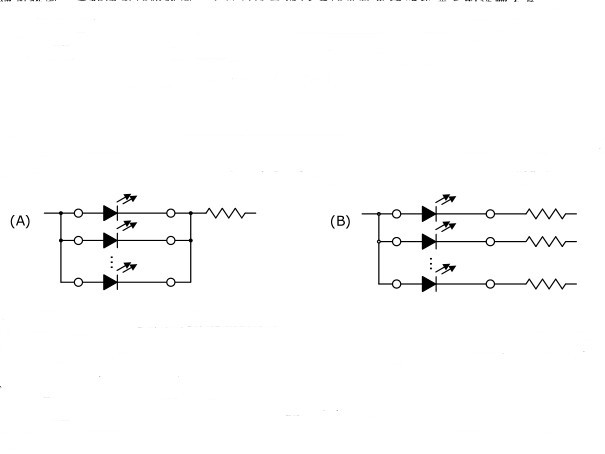
How do you connect an LED to a power supply? When designing a circuit, take care to ensure that the variousThe current through the LEDs exceeds the absolute maximum rating. It is advisable to drive each LED with a constant current. If a constant-current drive is used, it is preferable to employ circuit (B) as shown below, as the differences in forward voltage across the LEDs in circuit (A) may result in uneven current distribution across the LEDs.
-
Please drive this product using a forward current. Please note that when this product is not in use, do not apply a voltage to it in either the forward or reverse direction. In particular, avoid applying a continuous reverse voltage to this product, as this may cause ion migration, resulting inThe LED has been damaged. If you do not intend to use this product for an extended period, you should switch off the main power supply as a precaution.
-
In order to ensure thatTo ensure stable LED performance, the applied current should ideally be 10% or higher than the rated current.
-
Avoid lettingThe LED is subjected to overvoltage events such as lightning surges.
-
When using this product outdoors, measures must be taken to ensure it is fully protected against water, moisture and salt damage.
-
This product also emits visible light; therefore, when using this product in sensors or similar devices, please ensure that the visible light does not interfere with the operation of the sensors.
-
The light emitted by this product contains ultraviolet (UV) radiation; exposure of the human body or other objects to this light may be harmful to health. The extent of any harm depends on the wavelength of the light, the intensity of the radiation and the duration of exposure. Users must be made aware of this when using this product in applications where it may have adverse effects on health. For precautions regarding ultraviolet radiation, please refer to the Nichia Chemical China website at“Application guide in ”Technical Data’: ‘Precautions regarding ultraviolet light (UV LED)》。
-
Components within the luminaire may be subject to accelerated deterioration; therefore, the effects of ultraviolet radiation should be thoroughly verified before selecting components. Furthermore, objects exposed to light from luminaires fitted with this product may also be subject to deterioration; users should therefore be advised accordingly, depending on the intended use of the luminaire.
-
The ultraviolet light emitted by this product causes a fluorescent effect, which may result in sensors and similar devices responding incorrectly. Users should therefore be advised accordingly, depending on the intended use of the luminaire.
-
When using this product in conjunction with otherLEDWhen used in conjunction with other devices, the ultraviolet light emitted by this product may cause otherLEDGlow. Therefore, when designing products for clients, it is best to avoid allowing otherLEDExposed to the radiation emitted by this product.
-
Prolonged storage or use of this product in high-humidity environments may accelerate chip degradation, resulting in reduced radiant flux. Store the product in the aforementioned environment. Before using this product, its reliability should be verified.
-
Avoid using this product in environments prone to condensation. Failure to do so may result in electrical leakage, which could reduce the radiant flux.