
The Principle of UV Sterilisation
-
The First Law of Photochemistry: Light must be absorbed by molecules in order for a photochemical reaction to take place. -
The Second Law of Photochemistry: A single absorbed photon can only activate one molecule to participate in the reaction. -
Photochemical reaction: Chemical reactions in substances, generally triggered by exposure to visible light or ultraviolet radiation, are reactions initiated when the molecules of the substance absorb photons. -
The most fundamental photochemical processes: When the energy of a photon absorbed by a molecule is greater than or equal to the dissociation energy of a particular chemical bond within the molecule, the molecule dissociates directly—a process known as photodissociation. 
We often talk about the length of a wavelength, but what is the relationship between wavelength and energy? Formulae for energy and wavelength conversion: E (energy) = 1240/λ (wavelength) The derivation of this formula is as follows: Unit: E (energy) — eV (electronvolts); h (Planck’s constant) — 6.63 × 10⁻³⁴J•s (joule-seconds); k (constant) — 1.6×10⁻¹⁹J/eV; C (speed of light) — 3×10¹⁷nm/s; λ (wavelength) — nm; E (energy) = 1240/λ (wavelength) It is clear from the above formula that:The shorter the wavelength, the higher the frequency and the greater the energy., so it is the shorter-wavelength deep ultraviolet that possesses the higher photon energy required to carry outSterilisation and Disinfection。 In theory, if the energy of a photon absorbed by a molecule is greater than the bond energy of the molecule’s chemical bonds, the chemical bonds can be broken.
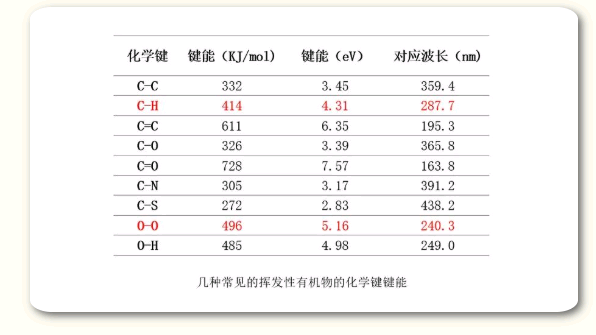
For example:
If a particular UVC product operates in the 280 nm wavelength range, then using the formula for the conversion of energy to wavelength, we can calculate that E ≈ 4.51 eV. Taking into account the bond energies of several common chemical bonds shown in the figure above, we can see that 4.51 eV is greater than the average bond energy of the C–H bond (4.31 eV); therefore, the C–H bond can be broken. Based on the conclusions above, we can list several commonly used results: 1. Wavelengths of 240.3 nm or below break the oxygen–oxygen bond (O₂) in the air, producing the more stable ozone bond (O₃). Consequently, the spectrum of our mass-produced UVC LEDs, which ranges from 250 to 280 nm with a half-width of approximately 10 nm, does not produce ozone (which is toxic, has a distinct odour and is harmful to human health). Mercury lamps contain spectral components below 240.3 nm; therefore, they do produce ozone.
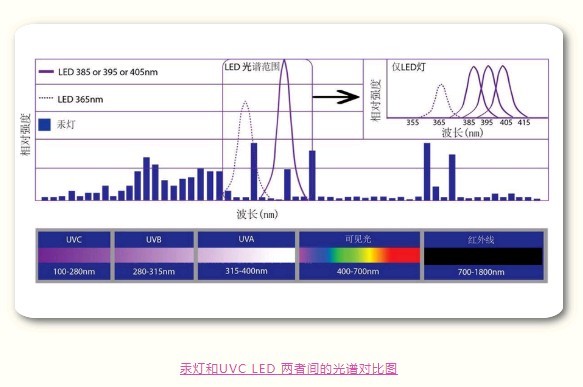
2. Thymine (C5H6N2The CH bond in (O) can be broken at 287.7 nm, thereby inactivating bacteria and microorganisms. So, you can use the conclusions drawn in this article to work out the results you are looking for. In the next article, we shall continue to explore the underlying principles and calculations behind the application of UVC LEDs.